Introduction
For physicians respecting the time-honored Hippocratic Oath, it is clear that induced abortion is a moral evil precisely because it involves the deliberate destruction of a human life. But there is also clear evidence that induced abortion is an independent risk factor for cardiovascular disease 1,2,3,4 gestational diabetes mellitus 3,5,6 thyroid-related diseases 6, placenta-related diseases 6,Asherman syndrome 7, increased risk of premature and low birth weight deliveries in subsequent pregnancies 8, and premature death from multiple causes 9,10. Even more common than physical sequelae, abortion is an independent risk factor for the onset or worsening of mental illnesses, as demonstrated in both record linkage studies 11,12,13,14 and case-control studies 15,16,17,18,19,20,21,22,23. These and other studies have firmly established that abortion may trigger, exacerbate, complicate, or otherwise contribute to new or existing mental illnesses. Perhaps more importantly, they consistently demonstrate that there are distinct pre-existing risk factors, and perhaps contributing factors, that can be used to reliably identify the women at greatest risk of the most severe post-abortion sequelae and should be utilized in both pre- and post-abortion counseling 15,16,22–41.
Notably, while the 2008 American Association’s Task Force on Mental Health and Abortion (TFMHA) asserted that there was no definitive evidence when, if ever, a single first-trimester abortion of an unwanted pregnancy by an adult woman is the sole and direct cause of any mental illnesses 42, it is also grudgingly admitted that abortion can contribute to emotional and mental health issues 22,42. More importantly, the TFMHA explicitly identified fifteen of the risk factors predictive of more adverse mental health outcomes: “Feelings of commitment to the pregnancy, ambivalence about the abortion decision, low perceived ability to cope with the abortion, history of prior abortion, late term abortion,” “terminating a pregnancy that is wanted or meaningful, perceived pressure from others to terminate a pregnancy, perceived opposition to the abortion from partners, family, and/or friends, lack of perceived social support from others, various personality traits (e.g., low self-esteem, a pessimistic outlook, low-perceived control over life), a history of mental health problems prior to the pregnancy, feelings of stigma, perceived need for secrecy, exposure to antiabortion picketing, use of avoidance and denial coping strategies” 42.
Notably, many of these risk factors (such as ambivalence, attachment to the pregnancy, and perceived pressure to abort from others) are markers for abortion decisions which are not consistent with a woman’s own preferences. Uta Landy, the former executive director of the National Abortion Federation, has described four common approaches which may lead to more regrets following an abortion. 43. The “spontaneous approach” involves such a rush to act that there is inadequate consideration of underlying feelings, future consequences and adjustments. The “rational-analytic approach” only considers the practical reasons for an abortion without regard for the emotional considerations. The “denying-procrastinating approach” delays the abortion decision due to ambivalence and conflict. The “no-decision-making approach” cedes the abortion decision to others, often in an effort to deny any responsibility for the decision.
Psychological counseling in the weeks immediately following an abortion can dramatically improve post-abortion adjustments 44. Therefore, identifying the subset of abortion patients who would most likely need and benefit from post-abortion counseling, based on readily identifiable risk factors, should be an important consideration in pre-abortion counseling. In addition, identification of risk factors is important to enable counselors to provide individualized counseling, including an evidence-based assessment of post-abortion adjustment issues that patients may face who have more or fewer risk factors for more negative outcomes.
Helping women to identify and understand their own individual risk factors during the informed consent process is essential as it may impact the woman’s pregnancy decisions. The 2009 textbook of the National Abortion Federation states that “patients with risk factors may require more time to reconsider options” 39. Women who believe that their individual risks are too high may prefer to reconsider alternatives other than abortion to resolve an unintended pregnancy.
The Royal College of Psychiatry in the U.K. stated in 2008 that prior to abortion, healthcare professionals “should assess for mental disorder and for risk factors that may be associated with its subsequent development,” pointing out that “consent cannot be informed without the provision of adequate and appropriate information regarding the possible risks and benefits to physical and emotional health.” 45
The principle that a patient’s individual risks should be disclosed in the informed consent process was established in the landmark federal appellate court case Canterbury v. Spence, 464 F2d 772 (D.C. Cir. 1972). As discussed in the AMA Journal of Ethics, “a physician is now required to disclose all risks that might affect a patient’s treatment decisions,” and it is also necessary to provide “personalized information about how the treatment might reasonably affect the particular patient,” going beyond merely general information 46. Thus, information about individual risk factors is essential for physicians to include in discussions with patients who are considering abortion.
To our knowledge, only one previous study attempted to measure the degree to which risk factors could be used to identify women who required additional pre-abortion counseling or post-abortion counseling referrals. That study, led by Elizabeth Belsey, identified five pre-existing criteria that were correlated with more negative emotional adjustments post-abortion (guilt; regret; disturbance of marital, sexual, or interpersonal relationships; or difficulty in coping with day-today activities) during the three-month follow-up period 47. Belsey’s team concluded that if pre-abortion screening for these five risk factors had been employed to determine which women would have been referred for more extensive counseling, this screening process would have resulted in both false negatives (missing eighteen percent of the women who did have one or more negative reactions) and false positives (twenty-eight percent of the women identified as higher risk did not have any apparent negative reactions at the three month follow-up interview). But, Belsey concluded, “From the clinician’s point of view this result can be viewed as erring on the right side, for a [screening] system that tends to select more women for counseling than is actually necessary is preferable to the reverse” 47.
To our knowledge, no subsequent research has been published to develop a protocol for pre-abortion screening, though clearly such screening should guide referrals for both more extensive pre-abortion and post-abortion counseling. It would also help to identify cases in which abortion may be contraindicated, such as when women are feeling coerced into an unwanted abortion which is contrary to their own maternal preferences. 32,48
Ideally, all the risk factors for abortion contributing to more adverse emotional and mental effects identified by TFMHA and others should be investigated. Moreover, factor analysis should be employed to eliminate redundant items and to more confidently develop a single, concise instrument for pre- and post-abortion screening.
While that project is outside the scope of our current resources, a subset of these risk factors was included in our national survey investigating the degree to which a random sample of women report facing pressures to abort contrary to their own values and preferences 32,33. The objective of this exploratory study, therefore, is to test whether a subset of known risk factors available in this survey can be meaningfully used to identify abortion patients who are at greater risk of subsequently attributing more emotional outcomes to their abortions in order to provide additional pre- and post-abortion counseling to this higher risk group.
Methods
A topic-blind survey was distributed through the survey panel services of Cint.com, which has over 28 million U.S. residents, to gather 1,000 completed interviews from a random sample of female panelists aged 41 to 45, inclusive. This age group was selected to reduce the confounding effects of time and age and to maximize the proportion of respondents with a history of abortion. Panelists completed the survey on their own electronic devices in exchange for small rewards valued at less than three dollars. The invitation to complete the survey did not describe the survey topic. Additional details about the sample have been previously published in a related analysis of pressures to choose abortion 49.
Developed in consultation with experts in abortion counseling and researchers who have published in this field, the survey included nineteen statements for which respondents rated their agreement on a visual analog scale, electronically coded on a 101-point scale from 0 to 100, inclusive. The statements and scales of agreement are shown in Table 1, along with the abbreviations for each statement as they are used in this study. The first 11 variables in Table 1 were treated as independent risk factors we hypothesized would predict the effects measured in the last 8 variables. Responses were mandatory for every variable, so there was no missing data in any completed surveys.
Table 1: Survey scale abbreviations, text of statements, and scales of agreement with values from 0 to 100
| Abbreviation | Complete statement | Scale of Agreement |
|---|---|---|
| EmotionalAttachment | My emotional attachment to the pregnancy was… | None at all | Very high |
| MaternalConflict | The idea of abortion conflicted with my maternal desires. | Not at all | Very much so |
| MoralConflict | The idea of abortion conflicted with my moral beliefs. | Not at all | Very much so |
| MalePr | I felt pressure to abort from my male partner. | Not at all | Very much so |
| FamilyPr | I felt pressure to abort from one or more family members. | Not at all | Very much so |
| OtherPr | I felt pressure to abort from someone else. | Not at all | Very much so |
| FinPr | I felt pressure to abort from financial concerns. | Not at all | Very much so |
| OtherCircPr | I felt pressure to abort from other circumstances. | Not at all | Very much so |
| MoreSupport | If I had received more support from others, I would have continued the pregnancy. | Not at all true | Very true |
| MoreFinSecurity | If I had more financial security, I would have continued the pregnancy. | Not at all true | Very true |
| PersonalPref | Excluding the pressures I faced to have an abortion, in terms of satisfying my own personal preferences the abortion was… | Very Unwanted | Very Wanted |
| HumanLife | I perceive the pregnancy as being . . . | A clump of cells | A human life |
| PositiveEmotions | My positive emotions regarding the abortion are . . . | None At all | Very high |
| NegativeEmotions | My negative emotions regarding the abortion are . . . | None At all | Very high |
| InterferedwLife | Thoughts and feelings about my abortion have negatively interfered with daily life, work, or relationships. | Not at all true | Very true |
| Needed Help | I have desired or needed help to better cope with negative feelings or behaviors due to my abortion. | Not at all true | Very true |
| IntrusiveThoughts | I have had frequent thoughts, dreams, or flashbacks to the abortion. | Not at all true | Very true |
| FrequentLoss | I have had frequent feelings of loss, grief, sadness about the abortion. | Not at all true | Very true |
| BetterMentalHlth | Abortion made my mental health . . . | Very much worse | Very much better |
An additional independent variable, abbreviated as DecisionType, was the categorical question: “Which best describes your abortion decision?” Respondents were presented with four possible answers: “Wanted and consistent with my values and preferences” (Wanted), “Accepted but inconsistent with my values or preferences” (Inconsistent), “Unwanted and contrary to my values and preferences” (Unwanted), or “Coerced and contrary to my values and preferences” (Coerced). For parametric analyses, these categorical responses were recoded from 1 through 4: Wanted, Inconsistent, Unwanted, and Coerced, respectively. In a previous study, it was found that this variable correlated well with lower or higher rates of negative effects being attributed to an abortion 32. For group comparisons, the group Wanted is treated as the control group since these women represent the most ideal subgroup of women having abortions who, of the four groups, are theoretically predicted to be at lower risk of negative outcomes.
To simplify the analysis, the five scales regarding pressures to abort (MalePr, FamilyPr, OtherPr, FinPr, OtherCircPr) were averaged into a single variable, AvgPr, due to the findings of a previous study, which supported the conclusion that AvgPr provides the best correlation to several outcome measures 49. In addition, after completing a reliability analysis, an overall risk factor scale, RiskScale, with a range from 0 to 8, was constructed for each respondent utilizing eight independent variables. A value of one was added to the RiskScale score for each of the six risk factors (EmotionalAttachment, Maternalconflict, MoralConflict, HumanLife, MoreSupport, MoreFinSecurity) with a score over 50, plus one for a score of PersonPref less than 50 (indicating that the abortion was contrary to the individual’s own personal preference, plus one for AvgPr greater than 20 (since an average of 20 over all five individual pressure scales would be equivalent to one score of 100 on at least one of the scales if all other four scores of zero).
The final independent variable utilized was the age at which respondents reported having their first abortion (Age1stAbortion), with any responses under 10 and over 45 set to the average age reported by all other respondents.
To better accommodate our focus on evaluating risk factors predictive of negative outcomes, four additional outcome variables were also calculated. The first was an assessment of the net negative emotions (if any) (NetNegEmotions), calculated by subtracting the score for PositiveEmotions from NegativeEmotions, yielding a possible range from -100 to +100. Second, the net negative mental health effect (NetNegMHeffect) was calculated using the formula (BetterMentalHlth-50)*(-2), yielding a range from -100 to +100, such that a positive value indicated that the respondent attributed negative mental health effects to her abortion and a negative value indicated an attribution of positive effects. Third, we created the variable MaxHarm which represented the highest value reported for any of the other negative outcome variables (NegativeEmotions, InterferedwLife, NeededHelp, IntrusiveThoughts, FrequentLoss, NetNegEmotions, NetNegMHeffect).
Our constructed RiskScale and MaxHarm scales were tested for reliability using Cronbach’s α analyses. The independent and dependent variables were further tested for their interactions using Pearson’s r correlations and examined for their relationship to DecisionType and RiskScale and to determine whether the single-item DecisionType could predict negative outcomes as well as the multi-item RiskScale Decisiontype and RiskScale, representing an experimental sum of all the risk factors, were then tested for their predictive values in regard to the highest degree of negative outcomes women attributed to their abortions as measured in MaxHarm.
Finally, Bayesian regression analyses were conducted to identify which combinations of risk factors were best fitted to predict each measure of negative outcomes that respondents directly attributed to their abortions. Unlike ordinary least squares (OLS) regression—which imposes a priori assumptions that can bias results and fail to detect associations not fitting those assumptions—Bayesian regression treats parameters as random variables, incorporates weakly informative priors, and derives posterior probabilities directly from the data. This eliminates assumption-driven distortions and allows identification of risk–outcome relationships that OLS might miss.
Analyses and figures were conducted using R-Studio (Build 576) and JASP 0.16.4. The study design was approved by the Sterling Institutional Review Board (ID:10225). Participants signed informed consent agreements with the survey distributor, Cint.com.
Results
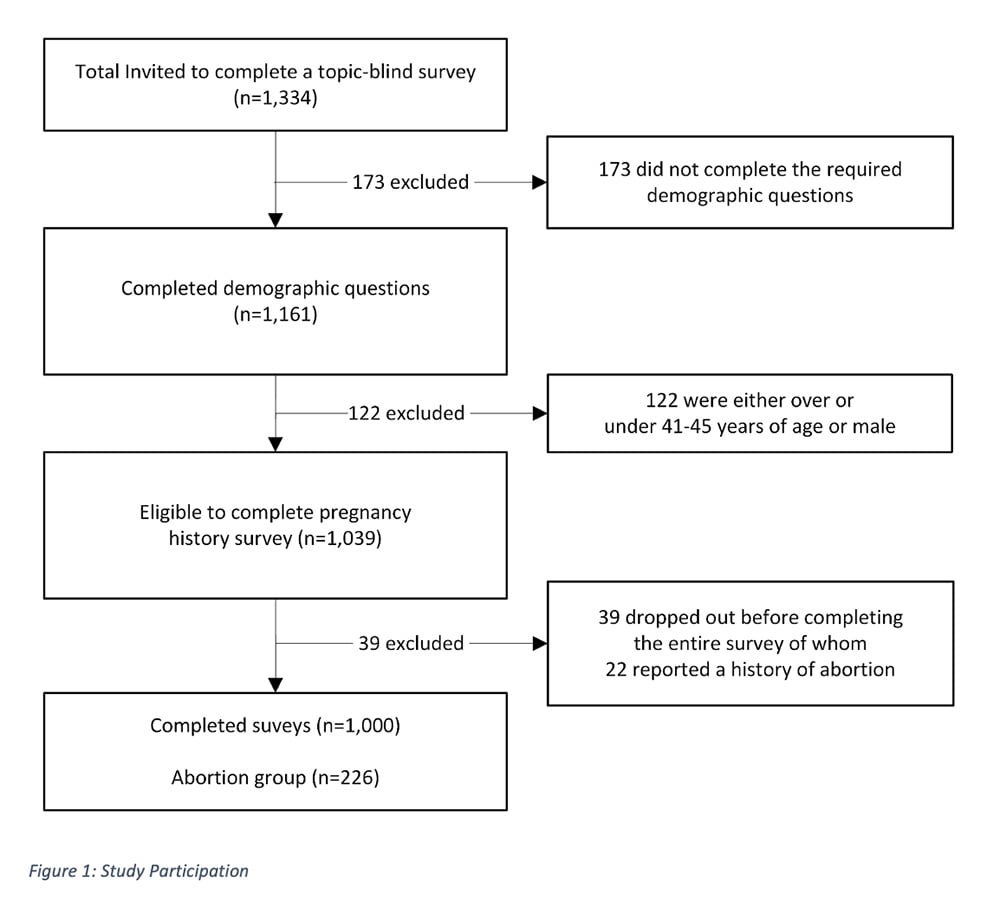
Figure 1 shows a flow chart of study participation. A total of 248 (23.7%) of 1,039 qualified respondents who began the topic blind survey reported a history of one or more abortions. Of those reporting a history of abortion, 226 (91%) completed the survey after the word “abortion” was first used. Women who reported a history of abortion were four times more likely to drop out before completing the survey than those who had not (OR=4.43, 95% CI=2.31-8.49). The percentage of women reporting abortions closely matches the Guttmacher Institute’s estimated lifetime rate (23.67%) for a history of induced abortions among American women over 40 years of age 50. The average age at the time of first abortion was 22.6. A previously published analysis indicates that the sample is reasonably representative of the national population overall demographics 49, but that the identified rate of abortions among blacks and lower-income women may be lower than what would be expected based on other reports 51
Figure 1: Study Participation
Additional details regarding the study population, sources of pressure to abort, and DecisionType have been previously reported 32,33 and are not replicated here. In summary, 33% of the sample reported their abortions as wanted and consistent with their values and preferences, 43% reported that their abortions were accepted but inconsistent with their values and preferences, 14% reported that their abortions were unwanted and contrary to their values and preferences, and 10% reported that their abortions were coerced.
As described in the methods section, an overall risk scale, RiskScale, was constructed from the eight risk factor scales included in our survey, and a scale measuring the greatest degree of adverse effects, MaxHarm, was constructed from seven scales measuring the degree of adverse effects that respondents directly attributed to their abortions. Unidimensional reliability tests yielded Cronbach’s α values of 0.874 (95% CI: 0.847 to 0.896) for the RiskScale and 0.880 (95% CI: 0.854 to 0.902) for MaxHarm. These high α values indicate good reliability and internal consistency for both the items in RiskScale and MaxHarm.
Descriptive statistics of the key variables are shown in Table 2. Additional descriptive statistics of the dependent and independent variables used for any constructed variables are included in the supplement 52. Notably, across the six scales for individual negative outcomes (0 to 100), the most frequent single response was 0, and approximately a fourth of all responses were above the midpoint of severity. This reflects the S-shaped response curves of these scales, with significant numbers of respondents reporting values at each extreme.
Table 2: Descriptive Statistics of Key Variables
| Scale (minimum to maximum) | Mode | Median | Mean | Std. Deviation | 25th percentile | 50th percentile | 75th percentile |
| DecisionType (1 to 4) | 2 | 2 | 2 | 0.93 | 1 | 2 | 2 |
| RiskScale (0 to 8) | 4 | 4 | 4.18 | 2.42 | 2 | 4 | 6 |
| NegativeEmotions (0 to 100) | 0 | 51 | 50.65 | 32.97 | 23.00 | 51.00 | 78.00 |
| InterferedwLife (0 to 100) | 0 | 30 | 35.71 | 32.98 | 3.00 | 30.00 | 58.50 |
| NeededHelp (0 to 100) | 0 | 28 | 33.95 | 32.72 | 2.00 | 28.00 | 61.00 |
| IntrusiveThoughts (0 to 100) | 0 | 22 | 33.20 | 33.61 | 1.25 | 22.00 | 59.75 |
| FrequentLoss (0 to 100) | 0 | 35 | 39.30 | 34.49 | 3.25 | 35.00 | 67.00 |
| NetNegEmotions (-100 to 100) | -100 | 0 | 0.28 | 55.65 | -35.75 | 0.00 | 37.00 |
| NetNegMHeffect (-100 to 100) | -2 | 0 | 1.94 | 46.74 | -21.50 | 0.00 | 30.00 |
| MaxHarm (0 to 100) | 100 | 61.50 | 59.69 | 31.58 | 40.00 | 61.50 | 87.00 |
| ᵃ The mode is computed assuming that variables are discreet. | |||||||
Table 3 shows positive correlations between all the variables. The Pearson’s r correlations between the negative outcome scales and Decision Type were of medium strength (0.3 to 0.5). However, using the standard conversion formula (d = 2r/√(1 − r²), a Pearson’s r correlation of 0.30 roughly corresponds to a Cohen’s d of approximately 0.63, which most guidelines would classify as a medium-to-large effect. RiskScale was more strongly correlated (r ~ 0.6 to 0.7) to all of the outcome variables except NetNegMHeffect.Additional descriptive statistics and all correlations between all the predictor variables and outcome variables are included in a separate supplement 52. These results indicate that RiskScale is a better predictor for both individual types of negative effects that women attribute to their abortions as well as for an overall measure of the highest degree of negative effects, MaxHarm, than DecisionType.
Table 3: Correlations Between DecisionType and RiskScale and All Outcome Variables
| Variable | 1 | 2 | 3 | 4 | 5 | 6 | 7 | 8 | 9 |
|---|---|---|---|---|---|---|---|---|---|
| 1. DecisionType | — | ||||||||
| 2. RiskScale | 0.558 | — | |||||||
| 3. NegativeEmotions | 0.476 | 0.714 | — | ||||||
| 4. InterferedwLife | 0.370 | 0.627 | 0.621 | — | |||||
| 5. NeededHelp | 0.365 | 0.640 | 0.592 | 0.838 | — | ||||
| 6. IntrusiveThoughts | 0.327 | 0.629 | 0.560 | 0.681 | 0.707 | — | |||
| 7. FrequentLoss | 0.355 | 0.708 | 0.585 | 0.669 | 0.689 | 0.805 | — | ||
| 8. NetNegEmotions | 0.493 | 0.617 | 0.886 | 0.559 | 0.523 | 0.496 | 0.505 | — | |
| 9. NetNegMHeffect | 0.318 | 0.401 | 0.472 | 0.453 | 0.426 | 0.391 | 0.468 | 0.588 | — |
| 10. MaxHarm | 0.443 | 0.689 | 0.802 | 0.689 | 0.662 | 0.684 | 0.748 | 0.704 | 0.509 |
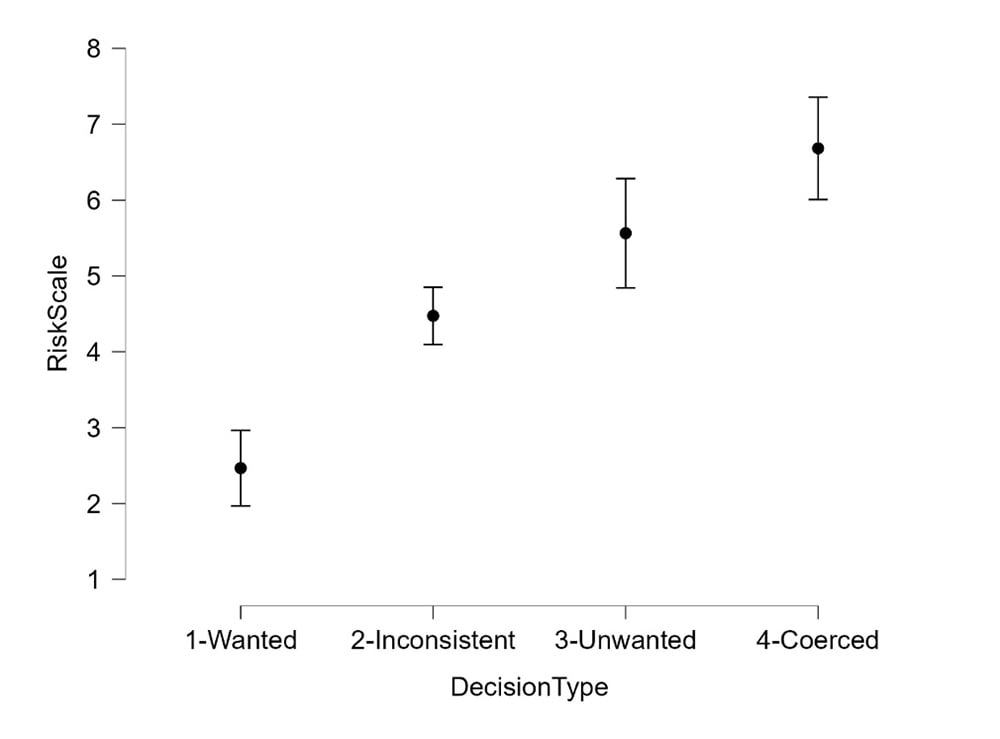
Despite the superiority of RiskScale in predicting negative outcomes, it is also strongly correlated to Decisiontype. Figure 2 shows that the RiskScale mean scores increase with each DecisionType further from the ideal, “Wanted and consistent with my values and preferences.” The mean RiskScale scores were 2.46 for women whose abortions were wanted, 4.47 for women whose abortions were accepted but inconsistent with their preferences, 5.56 for those whose abortions were unwanted, and 6.68 for those who experienced coerced abortions. Similarly, as shown in a separate supplement 52, distinct differences relative to DecisionType were observed across all predictor and outcome variables 34.
Figure 2: Mean RiskScale scores, with 95% confidence intervals, by DecisionType
However, RiskScale was more strongly correlated to MaxHarm (Pearson’s r = .689; 95% CI 0.614 to 0.752) than DecisionType ((Pearson’s r = .443; 95% CI 0.332 to 0.542). Figure 3 shows the mean and confidence intervals for each point in the RiskScale (range 0 to 8) relative to the MaxHarm value (range 0 to 100) The figure shows a good progression suggesting that higher RiskScale values show a proportional relationship to higher levels of MaxHarm.
Figure 3: Mean MaxHarm scores with 95% CI relative to RiskScale Scores
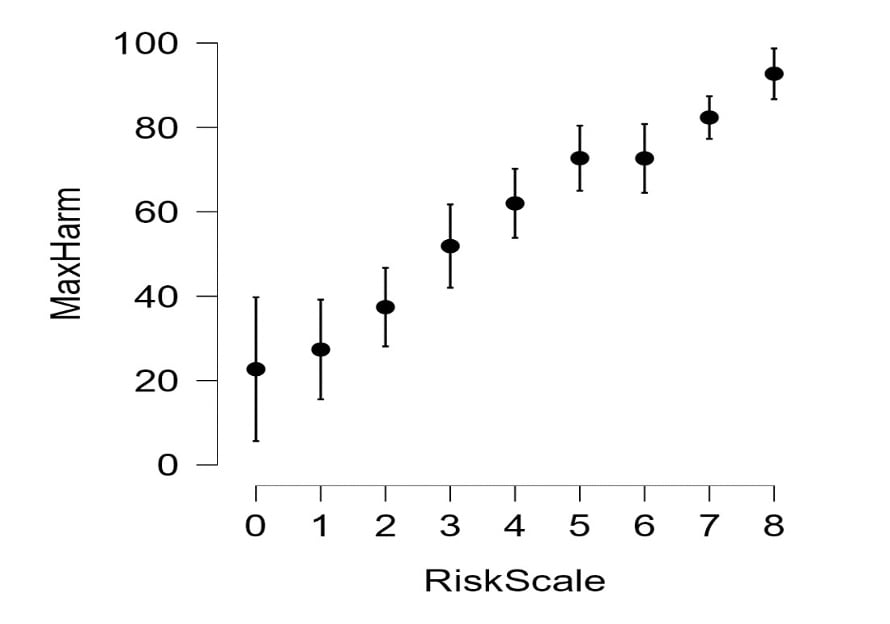
Table 4 shows the distribution of MaxHarm scores, segregated by the RiskScale scores, with the percentage of respondents above and below three MaxHarm cut-off scores (20, 50, and 80). Overall, 15.9% of the women attributed little to no harm to their abortions (MaxHarm<21), 84.1% reported moderate to severe negative reactions (MaxHarm> 20) attributed to their abortions, 64.2% attributed significant to severe reactions (MaxHarm> 50) to their abortions, and 32.3% rated one or more negative effects as severe (MaxHarm> 80). Among the latter group, one of the 73 women (1.3%) reporting MaxHarm>80 had a RiskScale of 0. Given the small number of women in many cells (n<10), our sample size is too small to establish reasonable confidence intervals for all cells in the tables. Still, the results are sufficient to identify general trends while also demonstrating that there will likely always be some outliers, especially among women with few or no identified risk factors.
Table 4: Distribution of women by RiskScale score and by MaxHarm threshold scores disaggregated by RiskScale scores
| RiskScale | Respondents below or above various MaxHarm score thresholds | ||||||||||||||||
| Total | <21 (little or no harm) | >20 (moderate to severe) | >50 (significant to severe) | >80 (severe) | |||||||||||||
| n | % | n | % | n | % | n | % | n | % | ||||||||
| 0 | 13 | 5.8% | 9 | 69.2% | 4 | 30.8% | 3 | 23.1% | 1 | 7.7% | |||||||
| 1 | 27 | 11.9% | 16 | 59.3% | 11 | 40.7% | 6 | 22.2% | 3 | 11.1% | |||||||
| 2 | 27 | 11.9% | 8 | 29.6% | 19 | 70.4% | 8 | 29.6% | 1 | 3.7% | |||||||
| 3 | 24 | 10.6% | 3 | 12.5% | 21 | 87.5% | 11 | 45.8% | 3 | 12.5% | |||||||
| 4 | 33 | 14.6% | 0 | 0.0% | 33 | 100.0% | 21 | 63.6% | 8 | 24.2% | |||||||
| 5 | 28 | 12.4% | 0 | 0.0% | 28 | 100.0% | 26 | 92.9% | 13 | 46.4% | |||||||
| 6 | 21 | 9.3% | 0 | 0.0% | 21 | 100.0% | 18 | 85.7% | 8 | 38.1% | |||||||
| 7 | 31 | 13.7% | 0 | 0.0% | 31 | 100.0% | 31 | 100.0% | 17 | 54.8% | |||||||
| 8 | 22 | 9.7% | 0 | 0.0% | 22 | 100.0% | 21 | 95.5% | 19 | 86.4% | |||||||
| Total | 226 | 36 | 190 | 145 | 73 | ||||||||||||
| % of Total | 100.0% | 15.9% | 84.1% | 64.2% | 32.3% | ||||||||||||
Bayesian linear regressions were run for each outcome variable using all of the significantly associated predictor variables. Age1stAbortion was not significantly correlated to the outcome variables and was therefore excluded from the Bayesian modeling. Only the highest of 512 models tested for each outcome variable are shown in Table 5. The top ten models and posterior summary results for each outcome variable are shown in a separate supplement 52. In most cases, R² was near or above 0.5, indicating that the model of risk factors tested explains 50 percent or more of the variance in the outcome variable. They also reveal that the different risk factors have greater predictive value for different outcome variables. This finding underscores the importance of evaluating a comprehensive list of risk factors.
Table 5: Bayesian Linear Regression results identifying the combination of predictor variables that most accurately model each negative outcome variable
| Outcome | Top Model | P(M) | P(M|data) | BFM | R² |
| MaxHarm | EmotionalAttachment + MoralConflict + MoreFinSecurity + HumanLife | 0.0008 | 0.086 | 118.339 | 0.555 |
| NetNegMHeffect | PersonalPref + HumanLife | 0.003 | 0.149 | 62.654 | 0.216 |
| NetNegEmotions | MoralConflict + MoreFinSecurity + PersonalPref | 0.001 | 0.373 | 498.734 | 0.535 |
| FrequentLoss | EmotionalAttachment + MoralConflict + AvgPr + MoreSupport | 0.0008 | 0.092 | 127.307 | 0.562 |
| IntrusiveThoughts | EmotionalAttachment + AvgPr + MoreSupport + HumanLife | 0.0008 | 0.273 | 473.262 | 0.495 |
| NeededHelp | EmotionalAttachment + MoralConflict + AvgPr + MoreSupport | 0.0008 | 0.124 | 178.429 | 0.480 |
| InterferedwLife | EmotionalAttachment + MoralConflict + MoreSupport | 0.001 | 0.139 | 134.906 | 0.494 |
| NegativeEmotions | MaternalConflict + MoralConflict + AvgPr + MoreFinSecurity + PersonalPref | 0.0008 | 0.127 | 183.315 | 0.627 |
Discussion
Main Findings
This survey of a national random sample of women who had abortions, on average, 20 years earlier, indicates that 84.1% of the women attributed moderate to severe negative reactions (MaxHam >20) to their abortions. Most women also reported multiple risk factors (average RiskScale = 4.18). if abortion had been flagged as contraindicated for anyone with more than one risk factor (RiskScale > 1), 82.3% of these abortion patients would have been flagged as at risk of moderate-to-severe psychosocial harm.
The results in Table 4 also suggest that even allowing women with a RiskScale score under two to proceed with an abortion (n= 40) would have resulted in 37.5% (n=15) subsequently reporting moderate to severe negative reactions and 10% (n=4) reporting severe negative reactions (>80) on one or more of the outcome scales.
Conversely, regarding false positives, using the same threshold (RiskScale>1), only 4.9% (n=11) with a RiskScale score over one would have been denied an abortion or referred for additional counseling, which in retrospect may have been unnecessary, since they would later attribute little or no harm to their abortions (MaxHarm<21).
If the threshold for referral was the presence of any risk factor (RiskScale>0), the percent of false positives would rise to 12.0%. Still, the risk of false negatives (failure to refer for additional counseling) would drop to 7.7% for severe reactions, 23.1% for significant-to-severe reactions, and 30.8% for moderate-to-severe reactions. Our relatively small sample size demands caution regarding these preliminary estimates, but the trends in the data are sufficient to support the general conclusion, as previously stated by Belsey, that the benefits of referring for additional counseling more often than necessary are most likely to outweigh the inconveniences associated with unnecessary referrals 47. Additional research is clearly necessary to improve and refine both the measures of pre-existing risk factors and the extent of negative outcomes they predict.
In our analysis, each of the 11 risk factors investigated was meaningful. But future research is necessary to investigate the prevalence and significance of additional risk factors reported elsewhere. 48,53,54,55 This should include better prospective, longitudinal studies with nationally representative samples of women across all age groups and validated scales for psychiatric assessments. More evidence-based screening practices will contribute to better pre-abortion counseling and decision-making, which reduce the incidence rate of coerced, unwanted, unsafe, and unnecessary abortions.
Strengths and Limitations
A strength of our study is its high participation rate in a sample reasonably representative of the national population of women aged 41-45 years. On average, this population had their abortions 20 years earlier, which gives them both greater perspective about their experience and greater distance, which may have improved response rates among those who would have been more likely to refuse to participate in a follow-up shortly after their abortions. In addition, we were able to assess the degree to which each outcome variable that respondents directly attributed to their abortions. On the other hand, the limitation of the sample to women in this narrow age group introduces the possibility that self-assessments of both the risk factors and outcome variables may be significantly different among younger women and women who are interviewed closer to their abortion experiences.
A weakness of the study, however, is that it is entirely retrospective and limited to a sample of women who had their abortions, on average, about 20 years ago. Memories and feelings may change over time and may introduce recall bias, including the influence of subsequently developed personal, political, or ideological beliefs. Ideally, the variables examined in this study should be used in longitudinal studies, such as the National Longitudinal Study of Adolescent to Adult Health, to evaluate how responses and participation rates may vary over time. In addition, this study is limited to U.S. residents. Future investigations should explore if there are any cultural influences on risk factors.
Another limitation is that our study examined a relatively small portion of all the risk factors that have been identified in the literature 48,53,54,55,56. Additional research should be conducted to investigate both other known risk factors and a larger variety of the negative outcomes (including both self-assessments and validated assessments of affective disorders, traumatic reactions, substance use, and suicidal behaviors) that have been reported elsewhere 55,57.
Additional limitations apply to terminology used in the questionnaire, which may be interpreted differently by respondents. For example, the word “coerced” may have different practical, social, or legal meanings to different respondents. Therefore, those who described their abortions as coerced may not have had abortions which would meet the standards defined for “coercion” under various state statutes. Readers should be aware that this term, like many terms used in the questionnaire, may be interpreted differently by respondents.
Finally, the eight items used to construct RiskScale do not include all the TFMHA-identified risk factors, much less all the additional risk factors identified by other reviewers. Additional investigations, including factor analyses, should be conducted to optimize a risk assessment scale. The scale developed and tested here has excellent internal consistency (Cronbach’s α = 0.874), but it may still be missing other items that are more important than the eight selected for this experiment. Additional testing and validation are highly recommended.
Interpretation
In our experience providing abortion services (PKG) and pre-abortion counseling (MS), screening for risk factors was not part of any training protocol. This lack of screening is consistent with what is reported in research examining counseling practices at 27 U.S. abortion clinics, which revealed that while the following components were “always” included: “1) Provide information about the procedure (96%), 2) assess the certainty of patients’ abortion decisions (92%), 3) assess patients’ feelings and provide emotional support (74%), and 4) provide contraceptive health education (92%)…”58, screening for risk factors predictive of negative emotional reactions was not mentioned. Yet systematic screening for risk factors is certainly warranted and even indicated in the National Abortion Federation’s textbook on abortion 59, which identifies 18 risk factors, including “commitment and attachment to the pregnancy,” and “perceived coercion to have the abortion.” While the authors, experienced abortion counselors, suggest that “patients with risk factors may require more time to reconsider options,” it is unclear if there is adequate training and implementation of this recommendation. Similarly, the American Psychological Association’s Task Force on Mental Health and Abortion identified 15 risk factors predictive of more negative outcomes 53 and analyses of these indicate that the majority of women undergoing abortions are likely to report multiple risk factors 55.
Research on how abortion counseling has evolved in the decades since 1973 gives insight into possible reasons why more attention to predictive risk factors may be lacking 60. In her report, Joffe, a former board member of the National Abortion Federation, concluded that politicization of abortion has negatively impacted abortion counseling practices. One counselor told her: “I think we fought so hard to protect abortion rights that there was a real hesitation on anybody’s part to address that [for] some women, abortion might be hurting them” 60. In addition, Joffe reported that administrative pressures to process patients through the intake process rapidly, often preventing counselors from taking the time they need to provide true individualized counseling to their patients.
Evidence-based pre-abortion screening of known risk factors is necessary for several reasons. First, screening is necessary to develop an evidence-based recommendation of whether the risks of abortion outweigh the benefits for each individual patient. Second, screening is necessary to properly personalize disclosures of risks to each patient that are relevant to her own risk profile as required by medical ethics and case law 46. Third, screening is necessary to identify pressures women may face to submit to abortions that are contrary to their own personal preferences and values. In such cases, health care professionals should be prepared to offer referrals, additional counseling or other assistance that might ameliorate these pressures and to assist the patient in finding resources that will help her to achieve her own reproductive preferences. Indeed, the American College of Obstetricians and Gynecologists has published committee opinions recommending that women should be screened for intimate partner violence 61 and reproductive coercion 62 at the first pregnancy visit and at least once a trimester during pregnancy. Such screening provides an opportunity to educate women and offer resources which can help to prevent coerced abortion.
Notably, prior research indicating that women who anticipate negative reactions to their abortions are more likely to experience negative reactions 37 has been used to advance an argument for censoring pre-abortion risk disclosures. The proponents of this view believe that withholding information “that stresses the negative aftereffects of abortion” is justified because exposure to these facts “may have a harmful effect on their adjustment to the abortion experience” 28. But this is purely speculation. Even the proponents of this hypothesis’ own study of different pre-abortion counseling methods revealed that counseling designed to bolster self-efficacy and confidence in one’s abortion decision resulted in only a small reduction in the incidence and degree of negative feelings, which lasted for only a few weeks after an abortion 63. Despite this failure, they hold that “Longer and more extensive counseling sessions might be expected to have longer-lasting effects” 28. But is it not more likely that the women who are most ambivalent about their abortion decisions, or feel pressured into abortions that are contrary to their own values and preferences (all TFMHA risk factors), quite rightly and accurately anticipate more negative feelings in the aftermath precisely because of their ambivalence and compromised decision-making? The best evidence suggests they are correct in their self-assessments. To pretend they are mistaken in their expectations is deceptive and unethical, representing an injustice and a failure of informed consent.
Medical ethics literature and court cases have addressed the issue of physicians withholding information about treatment risks when it is anticipated that knowledge of those risks might cause the patient to decline a treatment that the physician believes would be beneficial. Murray, citing Carr vs. Strode, states that “a physician must disclose information that a reasonable person would want to have for decision making, even though that information may cause the patient to refuse treatment that the physician believes is in the patient’s best interest” 46,64. The World Medical Association (of which the A.M.A. is a member organization) points out that under the “medical paternalism” of the past, it was acceptable for a physician to decide what was best for the patient and make treatment decisions with limited communication, but those days are long past. Today, “a mentally competent adult patient has the right to give or withhold consent to any diagnostic procedure or therapy” and “has the right to the information necessary to make his/her decisions” 65.
Ethics literature and the courts do recognize a “therapeutic privilege” to withhold information about risks of treatment only very rarely, in extreme circumstances 1) if the person is unconscious and may need emergency treatment or he benefit of the treatment clearly outweighs any harm or 2) if the person would be seriously harmed by disclosure of risk, for example if the patient were so emotionally upset that they might become incapable of making a rational decision. But information about risks may not be withheld merely because it could cause someone to decide not to undergo the treatment the physician prefers 25,46,65,66,67. This is especially true regarding abortion decisions, since there have been cases where abortion providers have exhibited racist or eugenic mindsets driving them to encourage and facilitate abortions that might be contraindicated purely to advance their own social engineering preferences 25.
Although there are multiple theories regarding the ethical principle of “justice,” it can be understood as “fairness” 68. Carr v. Strode, citing Bernard v. Char, states “since the patient must suffer the consequences, and since he or she bears all the expenses of the medical treatment, fundamental fairness requires that the patient be allowed to know what risks a proposed treatment entails.” 64. The Belmont Report also considers justice as fairness in the distribution of burdens and benefits. 69. When a physician fails to disclose individualized risk factors, a high-risk individual may be forced to bear a greater burden of risk without their knowledge or consent.
Moreover, by providing accurate evidence-based information confirming to these women that they will likely face more post-abortion adjustment issues can serve several good purposes. First, it is an essential right of patients, especially when undergoing an elective procedure, to be informed of all risks associated with the procedure so that they can make their own informed decision about whether any hoped-for benefits are likely to outweigh the possible risks 25,70. Second, our data reveals that approximately one in four abortion patients may be at risk of feeling pressured to undergo unwanted or coerced abortions. In these and other cases, providing women with evidence-based information confirming their expectations of being at higher risk of negative emotional reactions may arm them with the information they need to explain and convince those pushing them into unwanted abortions as to why an abortion, in their unique personal circumstances, may lead to lasting harms. Third, if abortion is chosen, it prepares them for the possibility and likelihood that they may need and benefit from post-abortion counseling. Fourth, if abortion is chosen, it will help to dispel the idea that there is “something wrong with me” because “everyone says I should be able to get over my abortion quickly.”25,70. In short, women are ill-served by the false impression that abortion is risk-free. It is not a panacea. Nor will it turn back the clock so that their lives will go on as if they had never been pregnant. In at least some cases, women are looking for reasons to not have an abortion, precisely so they can use that information to convince loved ones who are pressuring them for an abortion, why it simply isn’t for them 25,71.
In short, the suggestion that women should be shielded from information about emotional risks associated with abortion precisely to reduce the incidence rate of emotional problems is both ill-conceived and a violation of patients’ rights to full disclosure of all risks associated with a medical procedure, even when causal paths have not yet been determined 70. We strongly disagree with this policy. Women deserve evidence-based screening and risk-versus-benefit assessments, as supported by the medical ethics literature and case law.
Indeed, there is no evidence of any physical or psychosocial benefits that are directly attributable to induced abortion, medical or procedural 22,23,25,72. Indeed, even the proabortion researchers who led the Turnaway Study have admitted that there is no psychological harm to being denied an abortion 73,74. Therefore, with no proven benefits and many substantial risks, it would seem clear that it is medically unethical to provide abortions 72,75.
For abortion proponents, these concerns about the negative effects of abortion on women may be secondary to the higher ideal of women being free to choose abortions, and to control their own bodies, including the risks that may follow 11,15,25.
Conclusion
There is general agreement that pre-existing risk factors can be used to identify those women at greatest risk of negative mental health outcomes which they attribute to their abortions 28,48,53,54,55,56. While limited to retrospective data, the risk scale developed in this study appears to offer an efficient means of identifying the subsets of women who may benefit from additional pre-abortion counseling, referrals for post-abortion counseling, and other interventions that may alleviate the pressures to submit to unwanted, coerced, or otherwise contraindicated abortions.
Most abortions are sought with the hope for psychosocial benefits. But in fact, there is no research demonstrating any measurable psychosocial benefits from abortion, for women in general or in specific subsets of women. Even the Turnaway Study, which was designed with the anticipation of proving psychological harms resulting from women being denied abortions, failed to find any such harms. Indeed, women who were denied abortions reported being overwhelmingly happy to have had their babies, with only 4% still wishing, five years later, that they might have had an abortion. According to the lead author: “I expected that raising a child one wasn’t planning to have might be associated with depression or anxiety. But this is not what we found over the long run. Carrying an unwanted pregnancy to term was not associated with mental health harm. Women are resilient to the experience of giving birth following an unwanted pregnancy, at least in terms of their mental health” 73.
Our findings confirm what common sense and traditional medical ethics suggest: a failure to screen for risk factors predictive of adverse reactions to abortion is medical negligence. Nowhere else in medicine would the failure to screen for such strongly correlated risk factors be tolerated.
Physicians respecting the time-honored Hippocratic Oath should be aware of these risk factors in order to be in a position to provide evidence-based counseling to women and families facing problematic pregnancies. They should also be aware of these risk factors so that they can provide expert testimony regarding the failure of abortion providers to provide evidence-based medical recommendations, screening, and risk disclosures.
Ethics approval and consent to participate: The study design was approved by Sterling Institutional Review Board (ID:10225). Participants signed informed consent agreements with the survey distributor, Cint.com.
Availability of data and materials: In order to allow the primary research team to complete and publish additional analyses, the data analyzed will be made available from the corresponding author after November 1, 2026.