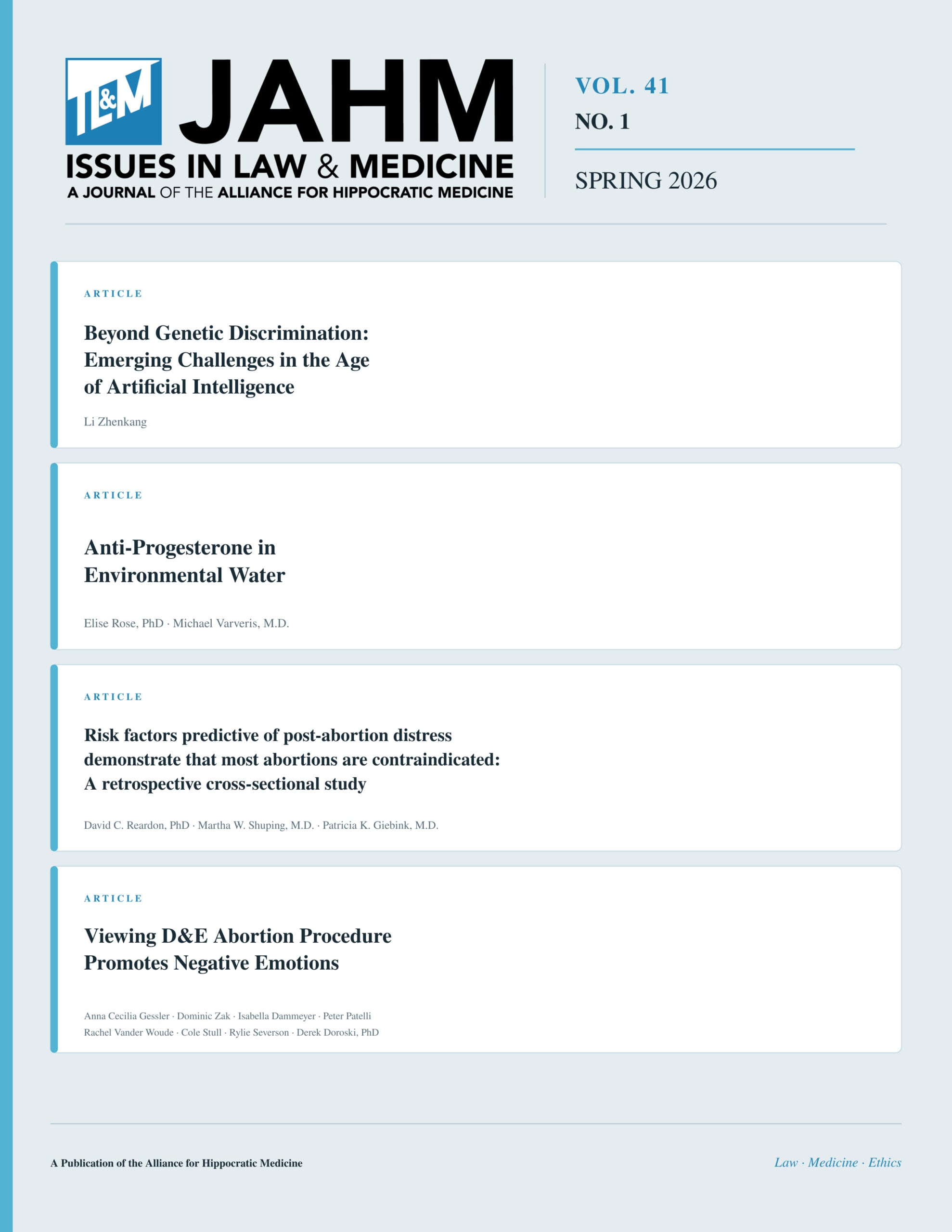
Spring 2026

ILM-Spring-2026-Cover-8.5x11-Extra-Large-Issue-Text
D&E-Video
  • Derek M. Doroski
  • Derek M Doroski
  • Rylie Severson
  • Cole Stull
  • Rachel Vander Woude
  • Peter Patelli
  • Isabella Dammeyer
  • Dominic Zak
  • Anna Cecilia Gessler
How well does the public understand what occurs during a second-trimester Dilation and Evacuation (D&E) abortion—and could seeing the procedure affect how people perceive it? Although D&E is the most common surgical abortion procedure used during the second trimester, many publicly available descriptions provide limited detail about what it involves. This lack of clarity may influence how patients and the broader public understand and evaluate abortions performed after the first trimester. In this pilot study, researchers surveyed participants before and after they watched an animated depiction of a D&E procedure. The study explored whether viewing the animation affected participants’ perceived understanding, emotional responses, and pro-life or pro-choice affiliations. The findings reveal notable changes in how participants understood and emotionally responded to the procedure, raising important questions about informed consent, public awareness, and whether greater knowledge of D&E may influence attitudes toward abortion over time.
PREPRINT
Edition: Spring 2026
Volume: 41
Issue: 1
Article: 4
Woman sits on a bed in a dark sweater, head bowed and hands covering her face, in a dimly lit bedroom with a bedside lamp and plant on the nightstand.
  • Patricia K. Giebink, M.D.
  • Martha W. Shuping, M.D.
  • David C. Reardon, PhD
For physicians respecting the time-honored Hippocratic Oath, it is clear that induced abortion is a moral evil precisely because it involves the deliberate destruction of a human life.  But there is also clear evidence that induced abortion is an independent risk factor for cardiovascular disease, gestational diabetes mellitus, thyroid-related diseases, placenta-related diseases, and Asherman syndrome increased risk of premature and low birth weight deliveries in subsequent pregnancies, and premature death from multiple causes.  Even more common than physical sequelae, abortion is an independent risk factor for the onset or worsening of mental illnesses, as demonstrated in both record linkage studies and case-control studies.  These and other studies have firmly established that abortion may trigger, exacerbate, complicate or otherwise contribute to new or existing mental illnesses. 
PREPRINT
Edition: Spring 2026
Volume: 41
Issue: 1
Article: 3
A glass dropper releases a single droplet above a clear vial in a blue-lit laboratory.
  • Michael Varveris, M.D.
  • Elise Rose, PhD
Past research has shown that endocrine-disrupting compounds (EDCs), including steroid hormones, synthetic estrogens and progestins found in oral contraceptives, are present in water supplies. This problem remains an environmental and health concern, especially given the widespread use of contraceptives and the increased prevalence of medication abortion in recent years. These compounds have a number of deleterious effects on human and animal biology, particularly aquatic animals. Small amounts of these chemicals (parts per trillion) can affect the endocrine system of animals and humans. Progestins, including specifically the anti-progesterone synthetic steroid hormone mifepristone, have been found to have disruptive effects on the fertility and reproduction of fish. Moreover, further highlighting the potential for environmental toxicity and contamination, the FDA recommends treating any unused mifepristone pills as hazardous waste.
PREPRINT
Edition: Spring 2026
Volume: 41
Issue: 1
Article: 2
DNA double helix with a binary code overlay, illustrating gene data and bioinformatics.
  • Li Zhenkang
With the deep integration of artificial intelligence and biotechnology, the paradigm of genetic discrimination is undergoing a fundamental transformation. Rather than relying on specific genetic markers, AI systems may infer individuals’ underlying biological risks through proxy data. This emerging form of discrimination, conceptualized in this article as “Algorithmic Proxy Genetic Discrimination” (APGD), is predictive, opaque, and structural. However, China’s existing Personal Information Protection Law and fragmented anti-discrimination framework remain insufficient to address this problem. In addition, APGD raises profound ethical and social challenges. To mitigate these risks, this article proposes a tiered regulatory approach: (1) controlling the misuse of proxy variables at the data input stage; (2) strengthening transparency and auditing in algorithmic decision-making; and (3) establishing an outcome-oriented mechanism for anti-discrimination liability and rights protection.
PREPRINT
Edition: Spring 2026
Volume: 41
Issue: 1
Article: 1
Search